Last week review 48-2026
This week it is already really cold, rather wet cold, but you are no longer used to such temperatures in the minus zone 🙁
Read more: Last week review 48-2026
This week’s article was about the migration of the DHCP server to OPNsense. For about a year, the ISC-DHCP server has been End of Life, which means that it no longer receives patches and is not maintained. As an alternative, OPNsense offers both the Kea-DHCP server and DNSMasq. The latter is especially suitable for smaller networks, such as my HomeLab.
I therefore decided to migrate the DHCP server to DNSMasq and at the same time changed the IP address range. With this, I want to prevent IP address conflicts from VPN accesses from other networks, for example. The problem here is the standard IP address ranges, such as those used by Fritz! Boxes or other routers.
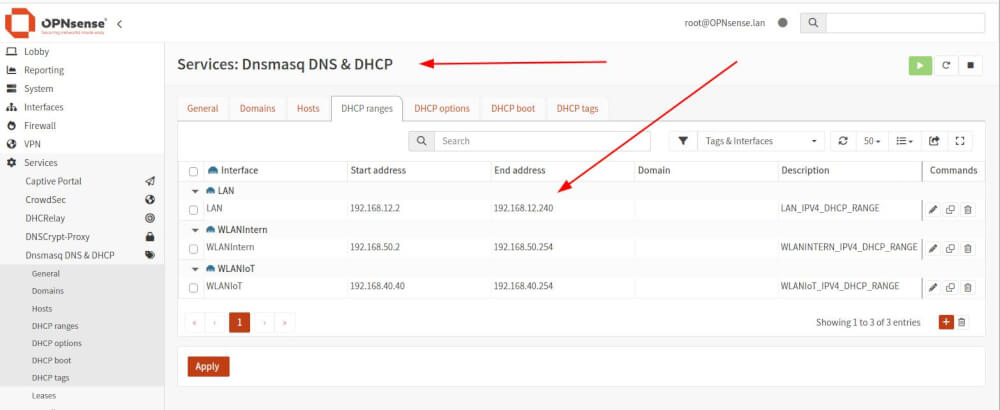
The changeover actually worked relatively well after I had defined another port for safety reasons, through which I can still access OPNsense. The new IP addresses were easily distributed from the defined range. Of course, there were still some problems here and there.

What you can easily overlook, however, is the fact that in how many configuration files under Linux are entered fixed IP addresses, which you then also have to change. This applies, for example, to the file /etc/resolv.conf in which the DNS servers are entered. But other configuration files also often contain fixed IP addresses.
In the meantime, these adjustments are largely done, and the conversion of the LAN IP addresses has worked well overall. The other networks, i.e. both the protected DMZ network and the WLAN networks, were not changed, so that no particular difficulties arose here.

Then this week there was the presentation of a new camera from Panasonic, namely the Lumix SHX1. This is a full-frame box video camera, as you already know it from the MFT range of Lumix.
Many had perhaps hoped that either a high-resolution DSLM or, for example, a successor model of the Lumix S9 would be presented. Unfortunately, neither is the case. So we may have to wait until the spring of 2027.
A remarkable message also went through the press: The New York Times forbidden photographers from using Photoshop from version 28.0, i.e. the current version.
Until now, very strict standards were applied to the processing of photos. For example, only image sections could be changed, and only to a very limited extent. So you always ran the risk that the resulting photo no longer correctly depicted reality.

Now the New York Times has pulled the line due to the increasing integration of AI functions, both generative AI and functions for removing image content and the like, and banned the use of the current Photoshop version.
This discussion was started a few years ago, when Luminar came on the market with its function to replace the sky. At that time, one could already ask the question: Is this an improvement of the image or already a manipulation?
While I still see the replacement of a sky area, which is then filled with interesting clouds, still relatively calm, because such a situation could theoretically correspond to reality, today’s functions go much further. Both in Lightroom and Photoshop as well as in other programs, photos and even videos can now be generated that are far beyond reality.
All in all, another very eventful week. I hope you like the articles and look forward to your questions and comments.
ciao tuxoche


